Leighann Ness Wilson is currently in the final stages of a PhD at Queensland University of Technology, exploring how pre-service teachers value and enact design as part of the Australian Design and Technologies curriculum.
Here, Leighann reflects on her HDR internship as part of the award-winning HEAL collaboration, which was completed early in her candidature.
When the universe aligns
There are moments in life when the universe just aligns. I realise it might sound unexpectedly woo woo for a blog about research training, but for me, an opportunity I had as a HDR intern turned out to be a full-circle moment that I still find hard to believe.
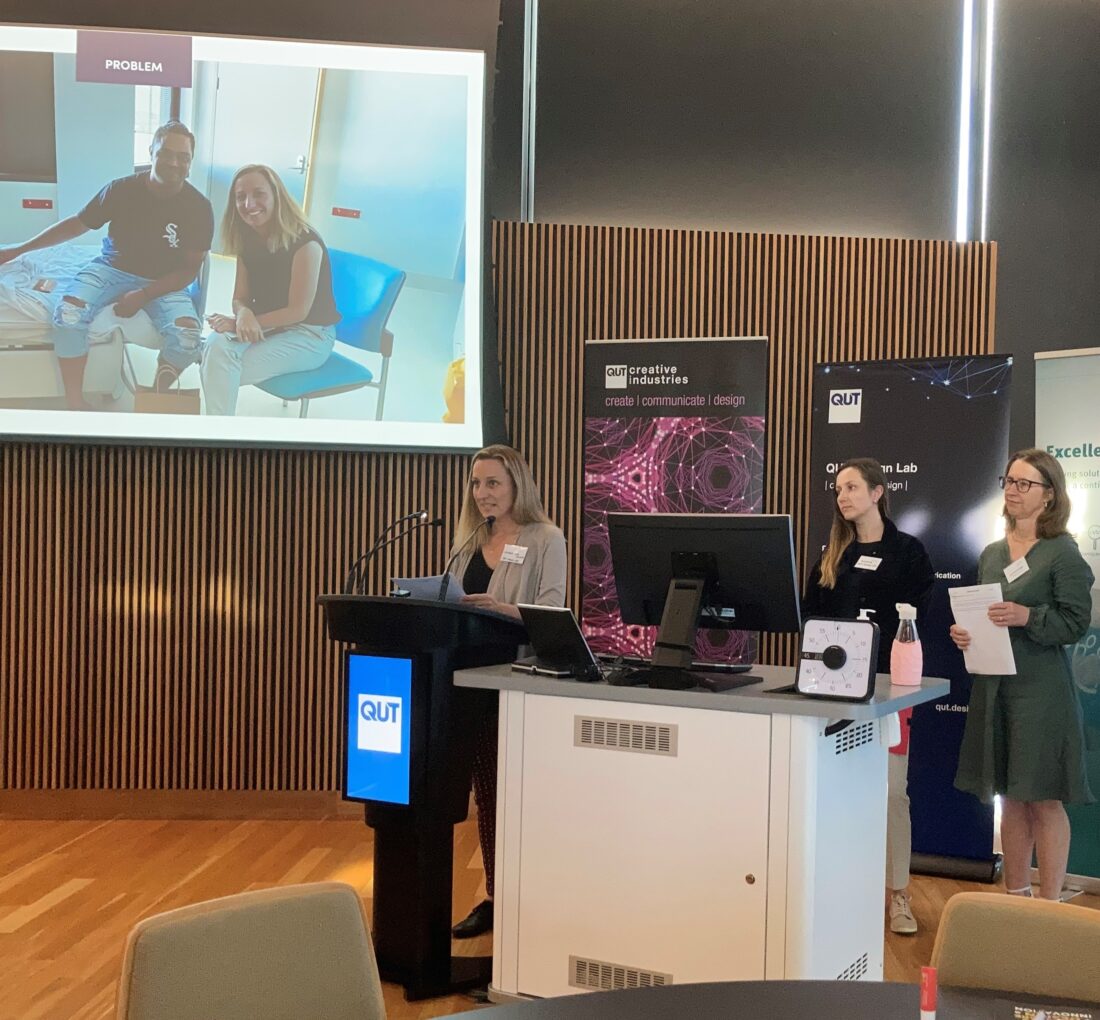
My name is Leighann Ness Wilson, and early in my research candidature at the Queensland University of Technology (QUT), I accepted an internship as part of the Healthcare Excellence AcceLerator (HEAL). HEAL, a collaboration between the QUT Design Lab and Clinical Excellence Queensland, saw designers embedded in healthcare settings across the state.
I was assigned to the PICU Partnership Project, which focused on the spatial environment and experience of families with a child in paediatric intensive care in the Queensland Children’s Hospital. While the internship utilised my undergraduate training and professional experience in interior design and offered me the opportunity to develop my research skills, it was the alignment with my lived experience that made this project feel personal. I knew I had to take it on.
At the project launch meeting, I joined design academics and researchers from QUT and clinicians, administrators, and policymakers from Queensland Health. As we went around the room introducing ourselves, I realised I was sitting right next to Ali, the physiotherapist who had cared for my tiny premature daughter in Neonatal Intensive Care (NICU) some 9 years earlier.
Towards the end of the meeting, I decided to speak up. I share with the group that I’d been a parent at the bedside of a child in intensive care. I also told Ali that while she might not remember me, I would never forget her. From that moment on, the clinical staff embraced me, and the research team looked to me for insights. The shared experience I had with the families we were there to understand became central to our research methodology.
Immersion in the PICU
My internship started with ‘Designer Immersion’, meaning I spent one full day a week in the PICU, getting familiar with the space, taking photographs and measurements, and making observations about the interplay between the spatial environment and human experience. Because the focus was on the families (not the clinical treatment or individual patient spaces), I purposely positioned myself in the family lounge and other public spaces. Here, I had a number of incidental conversations and found if I briefly mentioned my own parenting experience, the family participants really opened up. If there was ever a parent who was willing to talk to us about our project, I’d make time to go and sit with them.
I heard from parents feeling overwhelmed and needing respite from the clinical spaces but unsure about where they were allowed to go. They expressed discomfort “walking past all the other sick kids” to access a cup of tea in the parent lounge. One father told me, “I went there once” (to the parent lounge). “Never again.” His son had been a PICU patient on and off for four years.
Over the course of the project, I spoke to families who’d just arrived and some who’d been in and out of the PICU over extended periods. I met families who lived in nearby suburbs and families who were far away from their homes in remote parts of the state. I also met a family who, I found out much later, had to leave the PICU without their child.
As a result of building trust with the research team, the clinicians of PICU also began to share their experiences. I heard from a doctor that the breast-pumping room was a good place to go to and cry, a sentiment echoed by a social worker, who told me that “we train our families to grieve like ninjas”.
From both sides, I heard how unworkable it was to have the parent bathroom outside the actual unit. To use the bathroom visiting family members had to leave the PICU all together, and then buzz their child’s nurse on the internal intercom, to be allowed back in.
The insights gained during designer immersion, coupled with the shared lived experience I had with the families, afforded me a deep understanding of the project. This insight became most visible when I proposed that a planned co-design workshop should be reimagined, responding to the nature of intensive care where forward planning and commitments of time are simply untenable. The result was the PICU Marketplace, a novel engagement method that ran for two days in the large main entry corridor. Recognising the demands of the PICU environment, participation was entirely voluntary and without expectation. Families and clinicians could choose to engage with the activities at a time and duration that suited them, or they chose to walk straight past us. The Director of PICU was so impressed with the marketplace as an engagement method that he suggested it to other hospital stakeholders, and it has been subsequently used to elicit family feedback in other units of the hospital.
Partnership in practice
Beyond the time I spent with the PICU parents, the highlight of my HDR Internship was easily the connections we made to our industry partners in Queensland Health. In this way project truly really lived up to its name as a partnership. Deep and sustained relationships were formed, on the basis of mutual respect, and shared vision and purpose. To this day, I have continued to work closely with members of the PICU Liberation Team, particularly Jane Harnischfeger, Nurse Educator at PICU at the time. From the very first day, Jane found me work space on the ward. She introduced our team to clinicians, allied health workers and families, and became actively involved in all of the engagement methods. Jane took me on tours of dedicated care spaces elsewhere in the hospital, and together we visited Hummingbird House, a bespoke paediatric palliative care facility which helped shape some of our spatial considerations.
Word spread about our approach, bringing together design methodologies to meaningfully explore the PICU experience. At the conclusion of the project, Dr Anastasia Tyrunina and I were invited back multiple times to present our findings and recommendations to other stakeholders in the hospital. Even now, a number of years later, the partnership continues, and Jane and I currently have a journal article under review highlighting the project outcomes.
Being involved in such a meaningful project early in my HDR journey was impactful on a number of levels. I learned so much about research, engagement and collaboration, and it also showed me the value of prior experience. As HDR students, we all bring our own unique educational and career experiences our research. We may have spent time in industry, working in fields that shape our world view and approach to teamwork and collaboration, and, of course, we all have life experiences.
Working as a HDR Intern helped me see how my own unique perspectives were shaping my developing researcher identity. I learned the value of bringing my full self to my work, and how doing so made my research contributions feel more genuine.
Ultimately being part of the PICU Partnership Project helped me realise that, as HDR students, we might have a lot to learn, but we also have a lot to give.
To read more about HEAL and Leighann’s HDR involvement, see the following open-access publications:
Design Thinking in Education: A Practical Guide for Teachers and School Leaders (Springer, 2024)
https://link.springer.com/book/10.1007/978-981-99-6811-4
Ness Wilson, L. (2024). NICU Mum to PICU Researcher: A Reflection on Place, People, and the Power of Shared Experience. In Design Thinking in Education: A Practical Guide for Teachers and School Leaders.
https://link.springer.com/chapter/10.1007/978-981-99-6811-4_20