2026 Winner Profile
ACGR Award for Excellence in Graduate Research Supervision
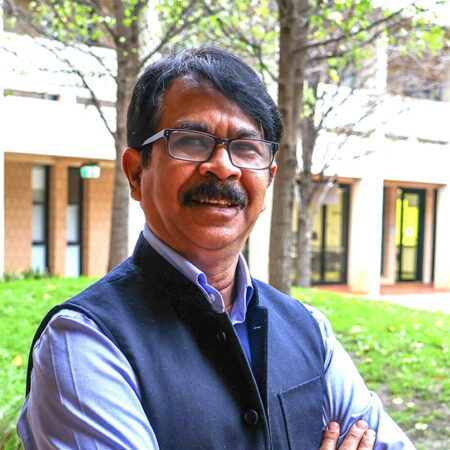
Professor Udoy Saikia
Flinders University
It was after midnight twenty-two years ago, the night before his PhD thesis submission when a young Udoy Saikia heard a knock on his office door.
It was his supervisor, with a flask of coffee. No university policy required him to be there. But that simple, late-night act of human presence built a lasting foundation of trust.
“Everything I have done as a supervisor since has been an attempt to replicate what he did,” says Professor Saikia, a social demographer at Flinders University and the recipient of the 2026 ACGR Award for Excellence in Graduate Research Supervision.
Over more than two decades, Professor Saikia has mentored 28 PhD candidates, primarily international students from diverse backgrounds, including Papua New Guinea, Timor-Leste, Indonesia, Sri Lanka and Mongolia. In a sector where international Higher Degree Research (HDR) students face the highest non-completion risks, his track record includes 21 timely completions, including 18 within three and a half years.
For Professor Saikia, effective supervision rests on three non-negotiable pillars: empathy, trust, and high expectations.
“Empathy doesn’t lower the bar. It clears the path to it,” he explains.
“International students arrive carrying cultural distance, language burden, family separation, and imposter syndrome alongside their research questions. When a student from a Confucian tradition has been conditioned to defer rather than challenge, I create structured conditions — contrasting datasets, written reflections, hypothetical questions — that make intellectual challenge feel safe.”
This supportive approach is coupled with high academic expectations. Seven of his students have received national or university-level research awards, while students’ research has contributed to UN Human Development Reports and informed national policy across the Indo-Pacific.
For Dr Collethy Jaru of Papua New Guinea, who says she began her PhD as “a complete novice in the world of research,” the support extended well beyond her research.
When severe financial hardships almost forced her to return home, Professor Saikia stood by her side, helping to secure tuition-fee waivers. Together, they co-designed a thesis that bridged scholarship with practical impact—focusing on how rural communities can use Indigenous knowledge to enhance food security in the wake of climate change.
Under his guidance, she went on to address the UN Development Network in Bangkok—the first Papuan PhD candidate ever to do so—and is now a Research and Projects Officer in Industry Skills and Advisory Council Northern Territory (ISACNT).
“He treats my ideas with intellectual respect and critical engagement,” Dr Jaru says. “Under his steady and fatherly guidance, I gradually found my footing and grew into the researcher I am today.”
For Dr Iriana Freitas of Timor-Leste, Saikia’s mentorship helped her connect her research on labour migration with national policy discussions, before securing a role as Country Coordinator at the International Trade Centre. Like Collethy, Iriana now also works for ISACNT as the Research and Projects Assistant Manager.
“He has a unique ability to explain complex concepts in simplified language, which is especially helpful for international students,” she notes. “Pursuing a PhD can be mentally and emotionally demanding, and his supportive guidance makes a significant difference in helping us move forward and not lose hope.”
This holistic development is the true measure of success for Professor Saikia. As he put it in his award submission:
“How do I know when my supervision is successful? Not at the moment of submission. I know it when a graduate phones to say they got the role, and I remember brokering the introduction eighteen months before. I know it when research produced under my supervision changes a government policy, informs a UN report, or opens a PhD pathway in a country that had none.”
In Mongolia, people traditionally pray at a child’s birth for three blessings: good health, prosperity, and a good mentor. The parents of one of Saikia’s doctoral students told him their daughter had found all three.
For this year’s winner of our Graduation Research Supervision, there’s one measure of success that matters more: “It’s not the position a graduate holds, but who they become.”