
Sherly Goh is the Industry Internship Liaison Lead at the Graduate Research School, University of Western Australia
For many HDR candidates, the most transformative learning does not occur within traditional research settings alone but through sustained engagement with industry and community partners grappling with real‑world challenges. Yet when we think about industry internships and research engagement, STEM disciplines often dominate the conversation. This reflects not necessarily a greater importance but their visibility, funding, and the different ways terms like “industry engagement” and “internship” are understood across disciplines.
Impactful research does not begin and end in a laboratory. Humanities and social science researchers ask questions that shape how societies think, govern, communicate and create, and increasingly they do so in partnership with the organisations and communities their work serves. In these fields, internships are a vital way of translating HDR research into practice, especially where impact is realised through people, policy and systems rather than patents or prototypes.
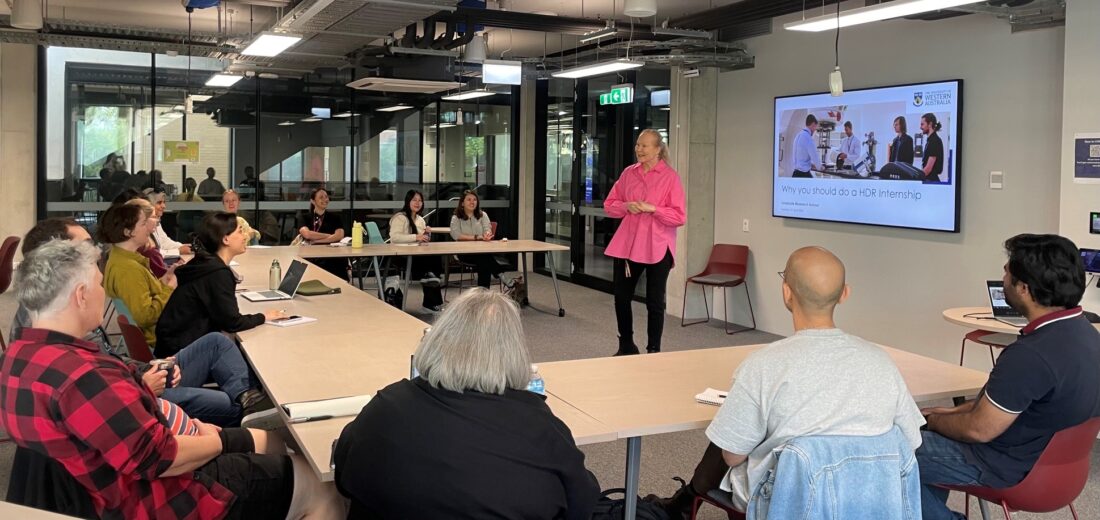
At UWA, three HDR students show how humanities research can create meaningful impact through heritage interpretation, language preservation, community partnership and policy. Their work may not produce a patent or prototype, but it shifts thinking, informs decisions and changes lives. Together, their stories show that industry engagement is not only a STEM story. UWA is committed to building the understanding, infrastructure and support needed to ensure every HDR student, regardless of discipline, has the opportunity to take their research into the world.
Story 1: Bringing History to Life: Researching Heritage at a Former Heritage Listed Site
A heritage-listed organisation in Western Australia was developing its first Aboriginal Heritage Management Plan and needed archival research and visitor insights to support more inclusive interpretation of the site’s Aboriginal history. A PhD candidate in History undertook an internship within the organisation, conducting archival research, visitor interviews and a report on past approaches to Aboriginal heritage interpretation. They also gained practical experience in planning, stakeholder engagement and heritage policy.
“The internship helped me connect my academic research with real-world impact. I saw first-hand how history is communicated in public spaces and how heritage professionals work to preserve and present it responsibly.”
The project informed heritage planning and supported more inclusive storytelling. It also enriched the candidate’s research and professional skills. Supervisor support was imperative in helping the candidate make connections and translate academic expertise into meaningful industry engagement.
Story 2: Supporting Language Preservation Through Community-Based Research
A PhD candidate joined the language program of an Aboriginal community organisation, combining academic research with practical work in language revitalisation and archival management. Over six months, the intern worked on site regionally and remotely when back in the city to support language preservation through archival processes, fieldwork, workshops and collaboration with language workers and researchers. The internship showed how academic skills can contribute to community-led initiatives grounded in trust and relationships.
The internship supported significant professional and personal growth, giving the candidate insight into community governance, archival practice and ethical research collaboration. Supervisor support was imperative in shaping the experience and making the connections that enabled it to succeed.
As the intern reflected, the experience provided an opportunity for meaningful collaboration, learning through relationships, and contributing to work with deep cultural significance. “This internship gave me a role and purpose in a community to which I had no previous connection,”the intern shared. “Through listening and learning, I built relationships, trust and understanding, alongside experiences that shaped both my research and who I am as a person.”
Story 3: Truth-Telling Through Heritage
A second-year PhD candidate in History completed an internship with a Western Australian government organisation on a heritage and truth-telling initiative. The researcher drew on doctoral research and archival investigation to contribute to an internal report exploring under-represented histories and their connection to contemporary heritage places.
The work generated strong engagement within the department and highlighted how historical research can broaden public understanding and inform reconciliation through heritage practice. Supervisor support was key to the success of the internship, particularly in making connections and helping the researcher move between academic research and government practice. The organisation supervisor also played a big role in accommodating and being flexible to the intern’s study load.
This internship illustrates how collaboration between universities and government can turn humanities research into meaningful social impact. By bringing underrepresented histories into heritage conversations, the project shows how research can help shape policy, education and community understanding.
Reflecting on the experience, the intern said it was “It was an excellent opportunity to apply my research in a real-world context,” and that, “The experience showed me how historical research can inform public understanding and contribute to Reconciliation.” She also reflected on the broader value of the work: “This project gave me the chance to grapple with complex historical and cultural issues and turn them into a narrative that could reach a broad audience,” adding that “It also gave me a new perspective on how the public service engages with history and community.”
Taken together, these stories reinforce why humanities and social sciences pathways matter, not only for individual graduates, but for the broader communities, sectors and institutions they serve. While the internship stories featured here are grounded in First Nations research and community partnerships, the value of this partnership-based approach extends across a broad range of disciplines and contexts. Humanities graduates bring resilience, adaptability, communication, creativity and collaborative capability to diverse professional, community and policy environments, while their subject-specific expertise enables them to contribute thoughtfully to complex social, cultural and policy challenges across a wide range of sectors and settings.
In the HDR context, these strengths are amplified through external and community engagement. As HASS PhD candidates build and sustain relationships beyond the university, they do not simply apply knowledge in non-academic settings, they help create reciprocal forms of knowledge exchange that benefit both research and practice. This is an important consideration for how we understand the value of humanities research and how we design future opportunities for engagement, supervision and impact.