
2026 Winner Profile
ACGR Award for Excellence in Graduate Research Programs and Support
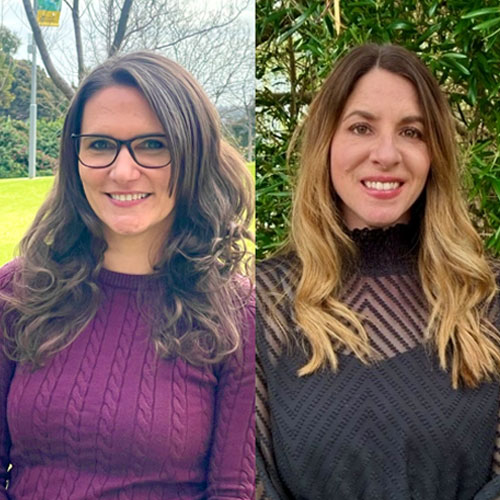
Dr Dani Milos and Rhiannon Vince
Flinders University
“Workplace training is like a gym membership: you only get out of it what you put in.”
The reflection of one Flinders University academic after completing supervisor development training captures one of the challenges facing any mandatory professional development program: how can we make required training genuinely useful?
At Flinders University, mandatory training has become something more: a forum for reflective professional growth. Almost 90 per cent of active HDR supervisors engage in supervisor development annually, reflecting a culture that values continuous learning and enhancement of supervisory practice. Alongside this strong participation, Flinders has achieved consistently strong HDR outcomes, including high rates of timely completion.
At the heart of this work is the HDR Supervisor Development Program, led by Dr Dani Milos and Rhiannon Vince, winners of the 2026 ACGR Award for Excellence in Graduate Research Programs and Support.
A central challenge identified by the Flinders team was the observation that supervisors are rarely supported as educators across the lifespan of a candidature. Instead, supervision often relies heavily on experience gained on the job. This means purposeful supervisor development is particularly important.
At Flinders, this learning led to a fundamental shift in how supervision is understood, positioning it as a teaching practice that requires preparation and development before commencing supervision, rather than professional development undertaken retrospectively.
The program is now structured as a reflective, developmental learning journey. Before supervising new HDR candidates, supervisors complete two Flinders-specific core components, combining online learning with an interactive workshop, followed by a choice of additional activities.
As part of the program, supervisors undertake a written reflective assessment that asks them to articulate their supervisory philosophy and expectations. This document outlines exactly how they intend to approach critical parameters of the relationship, like communication, authorship, ethics, and decision-making.
Crucially, written reflections receive personalised, developmental feedback from the team. This feedback is designed to translate potentially abstract policy into active, reflective practice. Once completed, the supervisor has a structured, written document ready to share and discuss with their new candidate from day one, establishing clear, explicit expectations from the outset.
The extraordinary success of the Flinders’ program lies in the complementary skills of its two leaders. Dr Milos brings fourteen years of experience in graduate research education and curriculum design. She designed and embedded Flinders’ Doctoral Graduate Attributes and Researcher Development Framework and established the HDR Supervisor Development Program. Rhiannon Vince, Senior HDR Support Officer, provides essential support to HDR supervisors through the administration of the Register of HDR Supervisors and the digital infrastructure that supports participation and professional development, including the Supervisor Development Dashboard.
The Dashboard gives supervisors and colleges access to training records, expiry dates, certificates, self-recorded learning and evaluation feedback, supporting informed workload and student allocation decisions.
The program has also prompted reflection among experienced supervisors. One principal supervisor with more than 14 years at Flinders reflected:
“Although I have been a principal supervisor for more than 14 years at Flinders, I have gained a greater appreciation of supervisory styles… and the need to adapt to the changing need of the candidate as they go through the various stages of their candidature.”
Professor Catherine Paterson, a current supervisor who completed the program in 2023, writes: “One of the most significant benefits of the program was the opportunity to develop my own teaching philosophy specifically for HDR supervision. While I had previously formulated teaching philosophies for both undergraduate and postgraduate education, I had not yet done so for HDR supervision. This program provided a wonderful opportunity for me to reflect and set clear expectations.”
The outcomes of this intentional pedagogical design are evident in the strong culture of supervisor engagement that has emerged at Flinders. Almost 90 per cent of active supervisors participate in supervisor development activities each year, despite engagement only being required on a biennial basis. The nomination describes this as more than compliance with a mandatory requirement; it reflects a broader cultural shift in which supervisors value the relevance, flexibility and personalised nature of the program and actively engage in ongoing professional learning. This culture of continuous development has been accompanied by strong HDR outcomes, including high levels of student satisfaction, with more than 90 per cent of HDR students reporting that they feel academically supported, guided and well served by their supervisors.
Beyond their own campus, national benchmarking has identified the Flinders model as distinctive for its use of reflective assessment and personalised feedback within a mandatory supervisor development framework.
The program has also been shared through invited presentations at QPR, HERDSA and the Postgraduate Supervision Conference, informing cross-institutional conversations about supervisor education.
By embedding reflection and ongoing development into supervisor education, Dani Milos and Rhiannon Vince have helped make supervision development an integral part of teaching quality and academic practice at Flinders University.