
2026 Winner Profile
ACGR Award for Excellence in Graduate Research Leadership
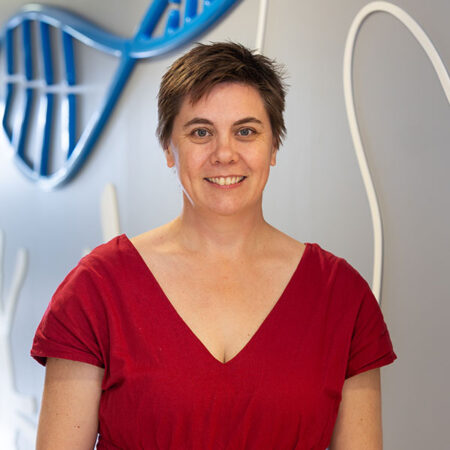
Professor Kathryn Burdon
University of Tasmania
At the Menzies Institute for Medical Research in Tasmania, more than 160 research-focused academics work across a broad range of disciplines and diseases, from molecular neuroscience to health services delivery. Yet for Professor Kathryn Burdon, the Institute’s Deputy Director, leading this intellectual community begins with a surprisingly simple premise: basic needs must come first.
“Intellectual communities thrive when its members have capacity for deep contemplation, which can only be achieved when one’s basic needs have been met.”
When Professor Burdon stepped into graduate research leadership – eventually becoming Menzies’ Deputy Director with strategic oversight of 90 to 110 higher degree research (HDR) students – she focused on creating a supportive environment in which students could thrive.
One of the first major challenges she tackled was financial stress. In 2023, student feedback revealed that the cohort was experiencing “extreme financial stress, significantly impacting their ability to thrive intellectually.”
At the time, only nine of the Institute’s 82 students held a top-up scholarship. Historically, these top-ups had been awarded intermittently, effectively as prizes, based on academic ranking processes or tied to specific projects, and were overwhelmingly directed towards domestic students.
Recognising that financial security and academic success are intimately connected, she advocated for a rapid expansion of the scholarship program to include financial need as a key criterion for funding.
Her advocacy succeeded. Through a mixture of institutional investment, research grant funding, and philanthropic donations, the program expanded dramatically. As of June 2026, 73 of the Institute’s 105 students receive top-up scholarships.
This emphasis on support also extended to the way academic difficulties were managed. Historically, “Candidature Support Plans” were not viewed positively. Many viewed them as a last resort or perceived them as punishment for poor performance. Through a sustained information campaign, Professor Burdon helped shift the culture around their use. Today, the plans are used as supportive, early-intervention tools. They require as much from the supervisor as they do from the student. GRCs now actively mentor supervisors, helping them recognise the challenges their candidates are facing and identify ways to support them through small changes in their own behaviour.
To address isolation, Professor Burdon initiated the student-led “Buddy to Buddy” (B2B) peer-mentoring program in 2024. With her support and advocacy, the program was designed by students for students, matching incoming candidates with established peer mentors. In its first 18 months, it achieved an 85% uptake among international candidates, with more experienced students volunteering to be buddies than there are commencing candidates.
Final-year PhD candidates and student leadership representatives Wardah Malick and Pantalius Nji Che describe the impact:
“Her approach is responsive and student-centred. By actively seeking and using candidate feedback, strengthening communication between HDR students and leadership… she has helped foster a culture where HDR students feel heard, supported, and connected to the wider research environment.”
Menzies’ HDR completion rate sits at around 95%, with data showing no difference in completion times between international and domestic students. There are also early signs of progress from the Institute’s new HDR Recruitment Strategy: early implementation doubled domestic student applications from four in 2025 to eight in 2026, alongside a seven-fold increase in the uptake of advertised priority projects compared with previous years.
For Professor Burdon, graduate research leadership is about developing independent, well-rounded researchers and citizens of the world. Under her guidance, the GRC team is trained in Mental Health First Aid, while the Institute has also worked to de-stigmatise carers, medical and other forms of leave by making their use a routine part of supporting student wellbeing.
As Burdon puts it in her award submission: “Our first responsibility is to safety and wellbeing in all its forms. When that is addressed, academic issues can be managed.”